


Latest News

New DFG-Funded Project on Hierarchical Al–Mg–Sc–Zr Alloys!
We are pleased to announce a new DFG-funded project on the development of surface–bulk hierarchical Al–Mg–Sc–Zr alloys. By combining ECAP and shot peening, the project will investigate how microstructural gradients and strain partitioning contribute to hetero-deformation-induced strengthening and improved mechanical performance.
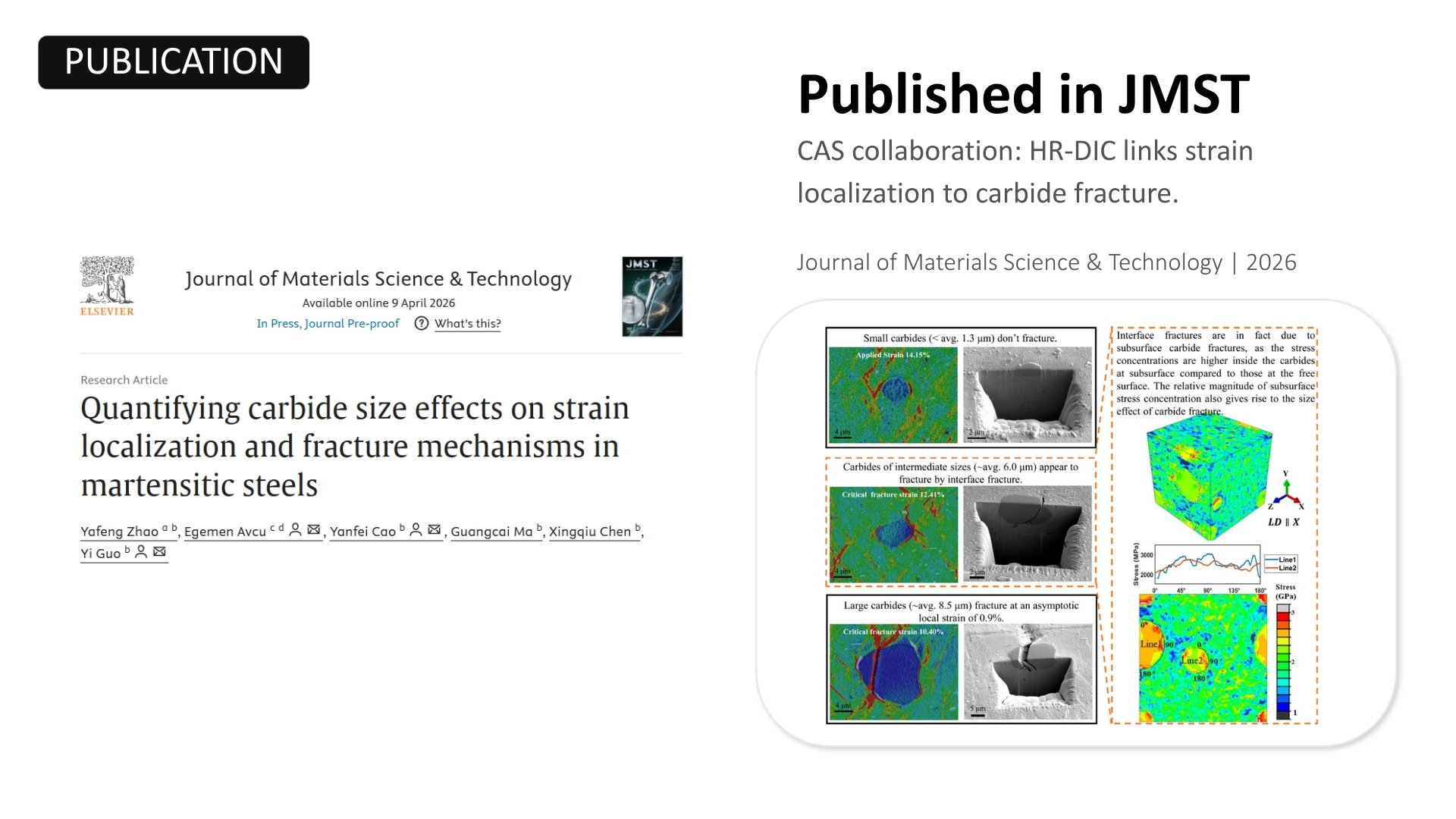
New publication in Journal of Materials Science & Technology!
Our article entitled “Quantifying carbide size effects on strain localization and fracture mechanisms in martensitic steels” has been published in Journal of Materials Science & Technology.
This study quantitatively investigates how carbide size affects local strain accumulation and fracture mechanisms in martensitic steels by combining high-resolution digital image correlation, FIB sectioning, and crystal plasticity modelling. The findings highlight carbide size as a critical microstructural parameter governing strain localization, damage evolution, and fracture behaviour in martensitic steels.
Article: Zhao Y., Avcu E., Cao Y., Ma G., Chen X., Guo Y., Journal of Materials Science & Technology, 275, 37–48, 2026.
DOI: 10.1016/j.jmst.2026.03.065

Our Student Awarded the YLSY Scholarship!
Ecem Süt has been awarded the prestigious YLSY Scholarship Program funded by the Republic of Türkiye Ministry of National Education.

Correlative Microscopy and HR-DIC of Grain-Boundary Mechanisms in Superplastic Alloys
We are pleased to contribute to a newly awarded TÜBİTAK 3501 project led by Dr. Berzah Yavuzyeğit. By combining correlative microscopy, HR-DIC, DVC, EBSD, and in-situ X-ray tomography, the project will reveal how grain-boundary sliding, dynamic recrystallization, local strain evolution, and cavity formation interact during superplastic deformation.

Surface Integrity and Bio-Tribocorrosion Engineering of GNP-Reinforced Ti-13Nb-13Zr
A newly awarded TÜBİTAK 3501 project will combine vacuum hot pressing and water jet shot peening to develop GNP-reinforced Ti-13Nb-13Zr bio-nanocomposites. Correlative analyses of microstructure, residual-stress gradients, nanoindentation, ion release, tribocorrosion, and fretting fatigue will reveal how internal GNP reinforcement and engineered compressive surface stresses can improve implant reliability.
About Us
We investigate microstructure–mechanics relationships in advanced alloys and composites, with a strong focus on severe plastic deformation (e.g., ECAP) and surface engineering (e.g., shot peening and related mechanical surface treatments). Using HRDIC-enabled in situ SEM together with correlative characterisation (e.g., EBSD, TEM/HRTEM, and X-ray CT), we uncover how hierarchical and hetero-structured architectures govern strengthening, strain heterogeneity, and damage resistance at the microstructural scale.
We translate these insights into advanced materials developed via powder metallurgy (PM), additive manufacturing (AM), and SPD-based processing for failure-critical applications (e.g., biomedical implants, aerospace structures, and energy/transport components).

OUR TEAM

Prof. Dr.
Egemen Avcu

Assist. Prof. Dr.
Yasemin Yıldıran Avcu

Prof. Dr.
Rıdvan Yamanoğlu

Assist. Prof. Dr.
Mustafa Armağan