
Our ongoing projects are organized around a mechanism-driven materials science framework, linking processing history, microstructural evolution, surface/subsurface integrity, local mechanical response, and final performance.
Select a research family below to explore the corresponding ongoing projects.
1. Correlative Microstructure–Mechanics & Damage Analysis
Microstructure, local mechanical response, deformation localization and fracture mechanisms.
2. Surface/Subsurface Microstructure–Property Engineering
Surface treatments, residual stress, hardness gradients, wear, corrosion and fatigue-related performance.
3. Deformation-Processed and Heterostructured Metallic Materials
SPD, ECAP, HPT, hierarchical microstructures, HDI strengthening and strain partitioning.
1. Correlative Microstructure–Mechanics & Damage Analysis
Microstructure, local mechanical response, deformation localization and fracture mechanisms.
Additive Manufacturing and Hydroforming of Optimized Tubular Components
Focus: Additive manufacturing, hydroforming, 316L stainless steel, tubular components, flow and mechanical property optimization
Status: Ongoing
Timeline: 2025–present
Programme / Research Network: CORNET Germany–Türkiye collaborative programme involving Fraunhofer Institute for Machine Tools and Forming Technology IWU, Forschungsvereinigung Stahlanwendung e. V. (FOSTA, Research Association for Steel Application), Additive Manufacturing Association (TAMA), and Kocaeli University, with academic links to Kocaeli University and Chemnitz University of Technology.
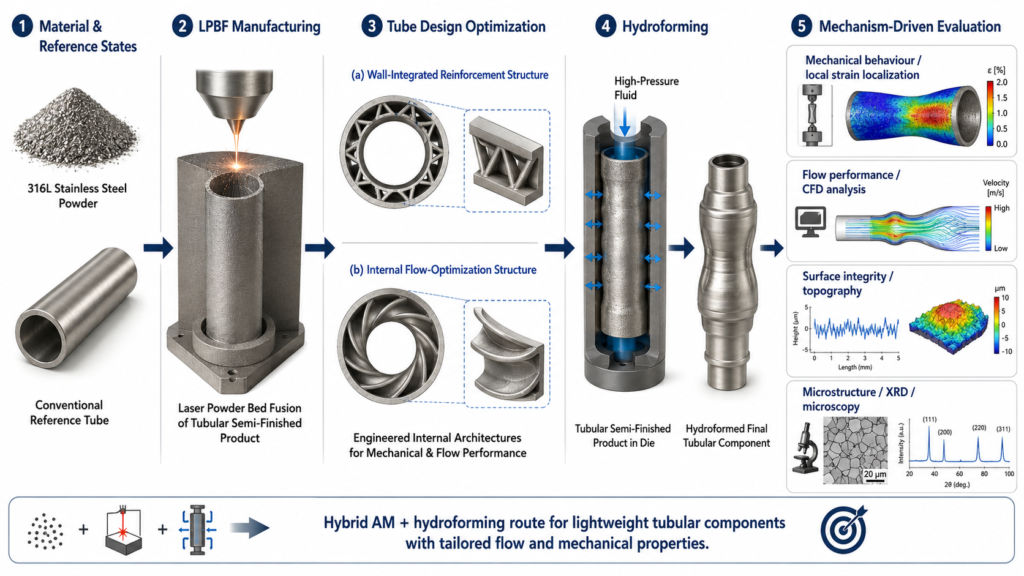
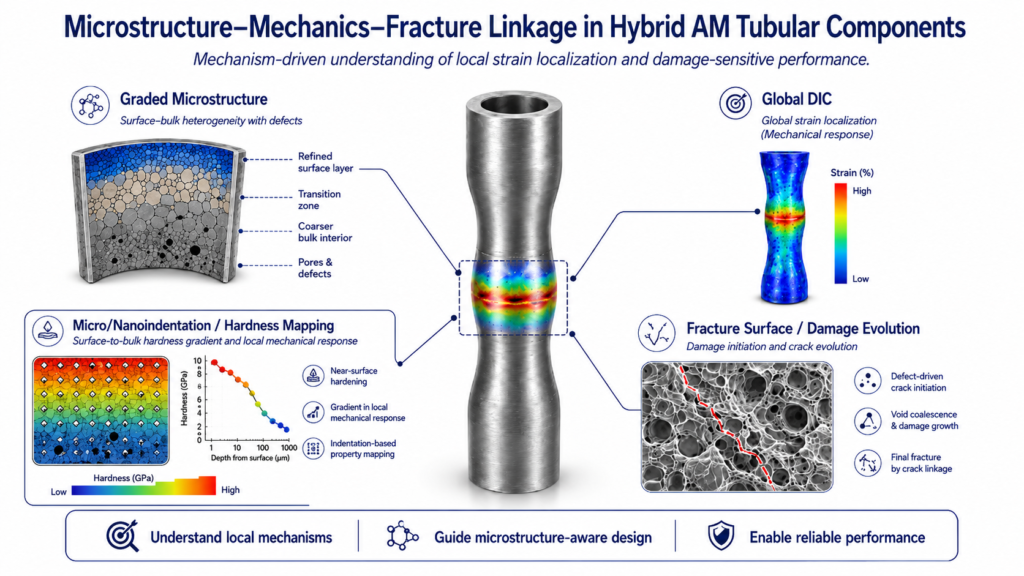
This project explores a hybrid manufacturing route in which LPBF-produced tubular semi-finished products are subsequently shaped by hydroforming. The aim is to combine the design freedom of additive manufacturing with the mechanical benefits of forming, enabling lightweight tubular components with tailored flow and mechanical properties. The current work compares additively manufactured and conventional 316L stainless steel tubes through mechanical testing, DIC-based strain analysis, surface topography, microstructural characterization, XRD, and computational flow simulations. The broader goal is to understand how processing route, surface condition, microstructural heterogeneity, and strain localization govern the performance of AM-derived tubular components.
Keywords: LPBF, hydroforming, 316L stainless steel, tubular components, DIC, CFD, surface integrity, strain localization, microstructure–property relationships.
Energy-Efficient Press Hardening of Thick Patch Blanks by Induction Heating
Focus: Press hardening, induction heating, thick patch blanks, high-strength steels, coating/microstructure/property relationships
Status: Awarded / Starting in 2026
Timeline: 2026–2029
Programme / Research Network: CORNET Germany–Türkiye collaborative programme involving Fraunhofer Institute for Machine Tools and Forming Technology IWU, Forschungsvereinigung Stahlanwendung e. V. (FOSTA, Research Association for Steel Application), Kocaeli Chamber of Industry (KSO), Kocaeli University (KOU), and Fraunhofer Institute for Mechanics of Materials IWM.
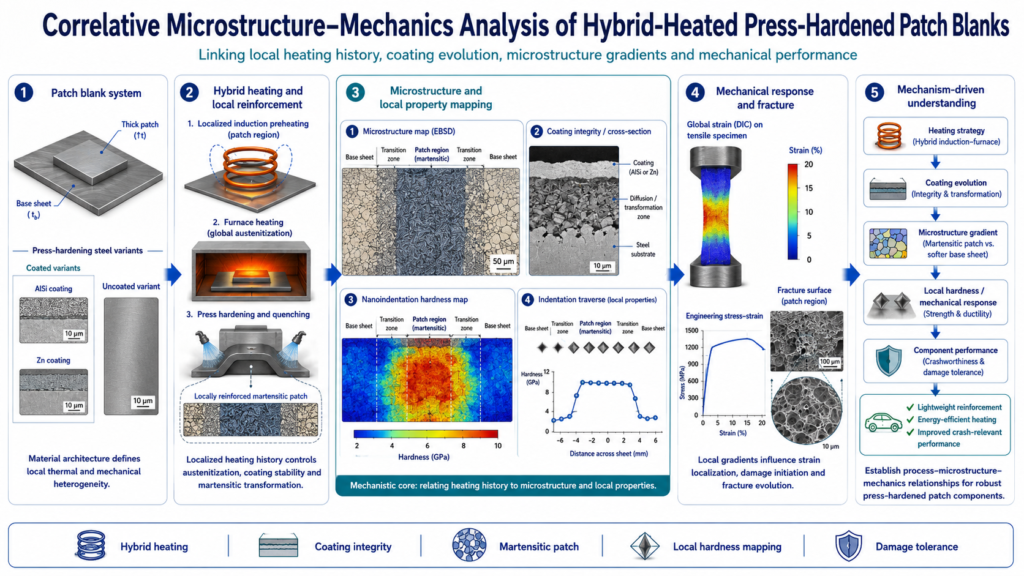
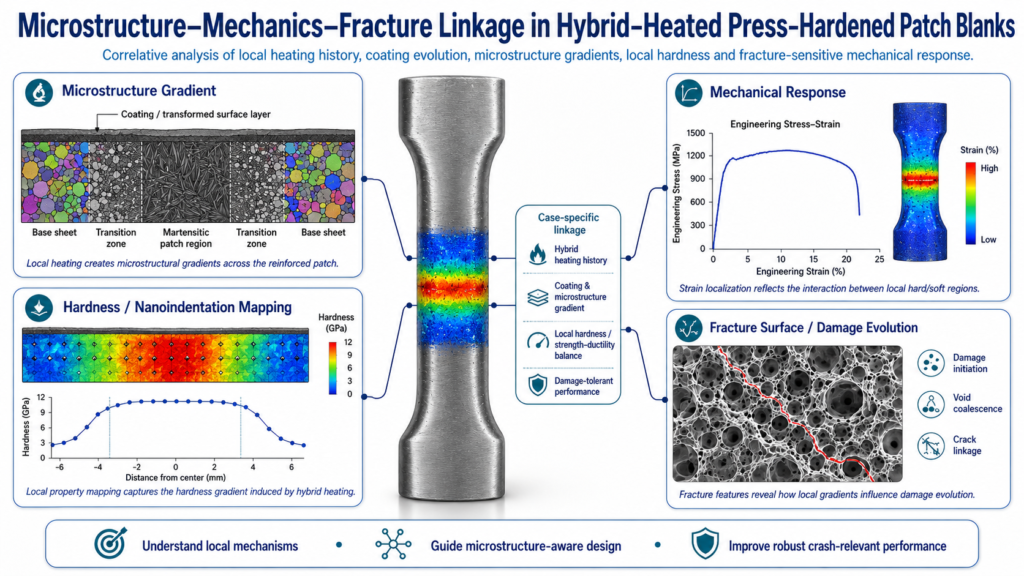
This project investigates energy-efficient heating strategies for press hardening of high-strength steel components reinforced with thick patch blanks. The aim is to combine induction heating with conventional furnace heating to reduce energy consumption while maintaining sufficient austenitization, martensitic transformation, coating integrity, and local reinforcement performance. The work focuses on coated and uncoated press-hardening steels, including AlSi and Zn-based coating variants, and examines how heating strategy, patch geometry, coating evolution, and local microstructure influence the final mechanical response. The research combines process-oriented thermal/mechanical testing, microstructural characterization, coating analysis, microhardness or indentation-based local property mapping, process simulation, and crash-relevant component testing.
The broader goal is to understand how local heating history and patch-blank architecture control coating stability, martensite formation, local mechanical properties, and energy-absorption behaviour in lightweight press-hardened components.
Keywords: press hardening, induction heating, thick patch blanks, high-strength steels, AlSi coating, Zn coating, martensite, microhardness, local mechanical properties, process–microstructure–property relationships.


In-Situ 3D Analysis of Grain Boundary Sliding and Recrystallization Mechanisms in Superplastic Alloys
Focus: Superplasticity, grain boundary sliding, dynamic recrystallization, in-situ 3D characterization, microstructure–mechanics relationships
Status: Awarded / TÜBİTAK 3501 Career Development Programme
Timeline: 2026–2029
Programme / Research Network: TÜBİTAK 3501 Career Development Programme, Recep Tayyip Erdoğan University, with contributions from Dr. Berzah Yavuzyeğit, Dr. Süleyman Karabal, Prof. Dr. Egemen Avcu, Dr. Tayyaba Rabnawaz, Prof. João Quinta da Fonseca, and Prof. Philip Withers.
This project investigates, in real time and three dimensions, how grain boundary sliding and dynamic recrystallization mechanisms interact during the deformation of superplastic alloys. The aim is to reveal how evolving grain structures, local strain fields, cavity formation, and recrystallized regions collectively govern superplastic flow behaviour.
The research combines in-situ three-dimensional characterization, digital image/volume correlation, EBSD-based microstructural analysis, and complementary mechanical evaluation to establish direct links between microstructural evolution and deformation response. The project is positioned around a mechanism-driven understanding of strain accommodation, grain boundary activity, recrystallization, and damage evolution during high-temperature deformation.
The broader goal is to generate microstructure-informed design principles for superplastic alloys with improved formability, deformation stability, and reliability.
Keywords: superplasticity, grain boundary sliding, dynamic recrystallization, in-situ 3D characterization, DVC, EBSD, X-ray tomography, deformation mechanisms, cavity evolution, microstructure–mechanics relationships.
2. Surface/Subsurface Microstructure–Property Engineering
Surface treatments, residual stress, hardness gradients, wear, corrosion and fatigue-related performance.
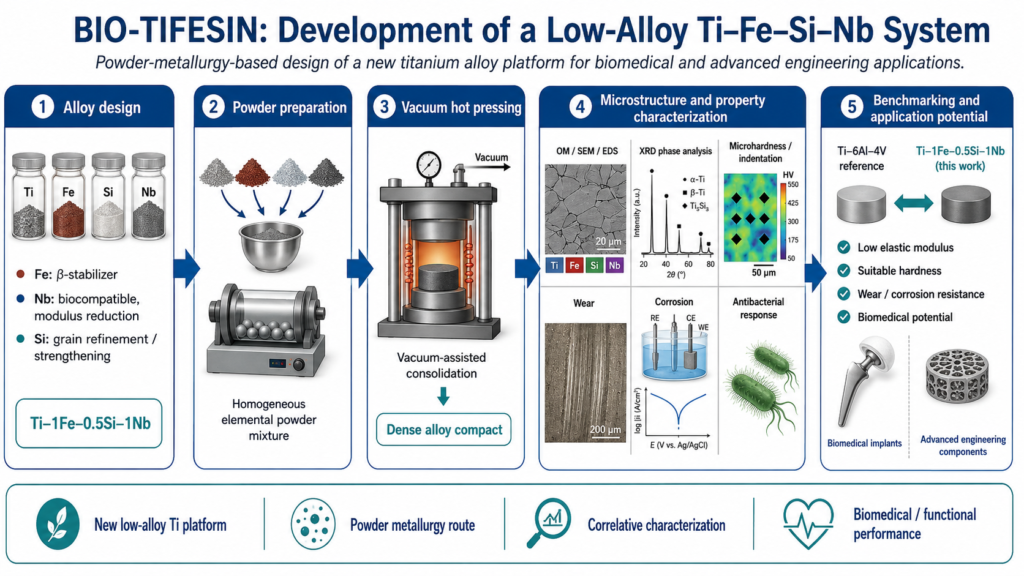
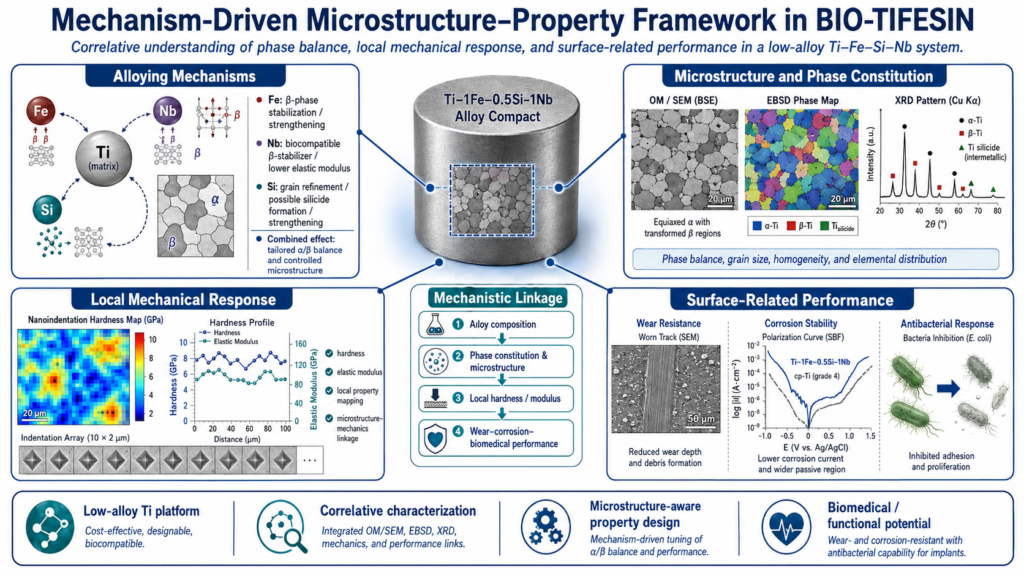
BIO-TIFESIN: Low-Alloy Ti–Fe–Si–Nb System for Biomedical Applications
Focus: Titanium alloys, powder metallurgy, vacuum hot pressing, biomedical materials, microstructure–property relationships
Status: Ongoing / TÜBİTAK 1002-A project
Timeline: 2025–present
Programme / Research Network: TÜBİTAK 1002-A Rapid Support Programme, Kocaeli University.
This project develops a new low-alloy titanium system, Ti–1Fe–0.5Si–1Nb, using elemental powder mixtures and vacuum hot pressing. The alloy is designed to combine the β-stabilizing effect of Fe, the biocompatible and modulus-reducing role of Nb, and the grain-refining/mechanical strengthening contribution of Si.
The research links alloy design, phase formation, microstructural homogeneity, local mechanical response, wear behaviour, corrosion resistance, and antibacterial performance. Ti–6Al–4V is used as a reference material to assess the biomedical potential of the newly developed alloy.
Keywords: Ti–Fe–Si–Nb alloy, biomedical titanium, powder metallurgy, vacuum hot pressing, microstructure, microindentation, wear, corrosion, antibacterial activity.
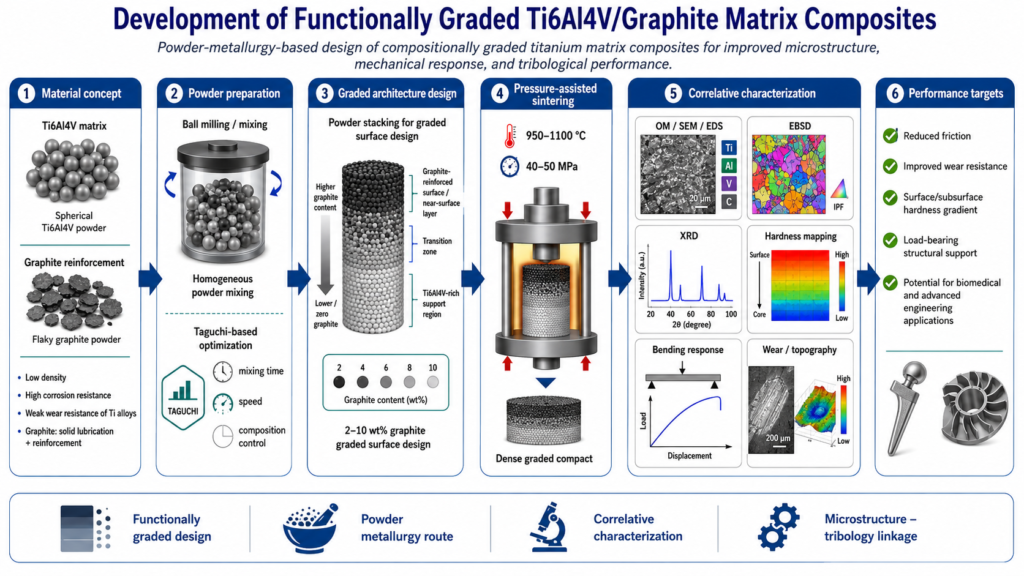
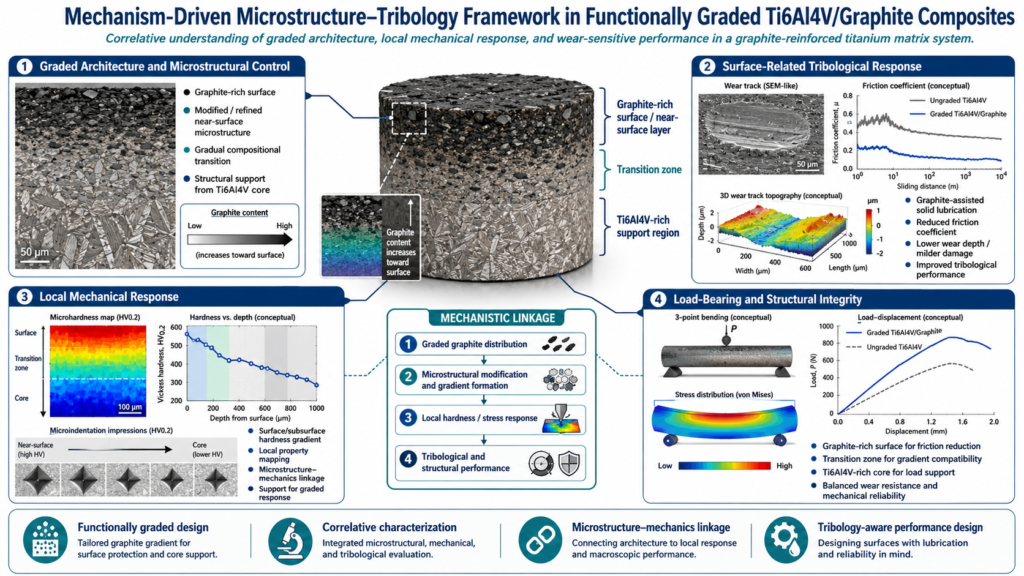
Functionally Graded Ti6Al4V/Graphite Matrix Composites for Enhanced Tribological Performance
Focus: Titanium matrix composites, powder metallurgy, functionally graded materials, graphite reinforcement, microstructure–mechanics–tribology relationships
Status: Awarded / Starting in 2026
Timeline: 2026–2029
Programme / Research Network: TÜBİTAK 1002-A Rapid Support Programme, Kocaeli University.
This project develops compositionally graded Ti6Al4V/graphite matrix composites using a pressure-assisted powder metallurgy route. The aim is to improve the weak wear resistance of titanium alloys by designing a graphite-rich surface/near-surface region while preserving the load-bearing capability of the Ti6Al4V matrix.
The work links graphite distribution, graded architecture, hardness gradients, bending response, friction behaviour, wear-track morphology, and surface topography. Through Taguchi-based process optimization and correlative characterization, the project aims to clarify how surface/subsurface compositional grading controls mechanical and tribological performance.
Keywords: Ti6Al4V, graphite reinforcement, titanium matrix composites, functionally graded materials, powder metallurgy, hardness mapping, bending response, wear resistance, surface topography.

GNP-Reinforced Ti-13Nb-13Zr Bio-Nanocomposites with Surface Integrity Engineering
Focus: Biomedical titanium alloys, graphene nanoplatelets, vacuum hot pressing, water jet shot peening, surface integrity, bio-tribocorrosion–fatigue performance
Status: Awarded / Starting in 2026
Timeline: 2026–2029
Programme / Research Network: TÜBİTAK 3501 Career Development Programme, with a multidisciplinary research framework linking titanium biomaterials, powder metallurgy, surface modification, residual stress analysis, tribocorrosion, fatigue, and in vitro validation.
This project focuses on the development of graphene nanoplatelet-reinforced Ti-13Nb-13Zr bio-nanocomposites using vacuum hot pressing, followed by surface integrity engineering through water jet shot peening. The aim is to combine the internal strengthening mechanisms of GNP reinforcement with the external protection provided by deep compressive residual stresses and graded surface modification.
The research links powder metallurgy, nanocomposite microstructure, surface/subsurface modification, residual stress depth profiling, nanoindentation, tribological behaviour, ion-release analysis, and bio-tribocorrosion–fatigue testing under simulated physiological conditions. A key methodological component is the design of an in vitro test system that combines fretting, cyclic loading, and simulated body fluid environment to assess implant-relevant degradation mechanisms.
The broader goal is to understand how internal crack-bridging, solid-lubrication and barrier effects from GNPs interact with surface-induced compressive stresses to delay damage initiation, reduce wear/corrosion synergy, and improve the reliability of next-generation titanium implant materials.
Keywords: Ti-13Nb-13Zr, graphene nanoplatelets, titanium matrix nanocomposites, vacuum hot pressing, water jet shot peening, surface integrity, residual stress, nanoindentation, tribocorrosion, fretting fatigue, biomedical implants.
3. Deformation-Processed and Heterostructured Metallic Materials


Surface–Bulk Hierarchical Al–Mg–Sc–Zr Alloys via ECAP and Shot Peening
Focus: Severe plastic deformation, shot peening, hierarchical microstructures, Al–Mg–Sc–Zr alloys, hetero-deformation-induced strengthening
Status: Awarded / DFG-funded project
Timeline: 2026–present
Programme / Research Network: Deutsche Forschungsgemeinschaft (DFG) funded project linked to Chemnitz University of Technology, with contributions from Prof. Martin F.-X. Wagner, Prof. Dr. Egemen Avcu, Dr. Yasemin Yıldıran Avcu, and Assoc. Prof. Dr.-Ing. Çağatay Elibol.
This project investigates the development of surface–bulk hierarchical microstructures in lightweight Al–Mg–Sc–Zr alloy systems through the combined use of ECAP and shot peening. The aim is to integrate bulk severe plastic deformation with graded surface modification to create refined, mechanically heterogeneous structures with improved strength, stability, and deformation tolerance.
The research focuses on how ECAP-refined bulk microstructures, shot-peened surface layers, strain gradients, and residual stress fields interact to produce hetero-deformation-induced strengthening. Correlative characterization methods, including microscopy, EBSD, XRD, hardness mapping, and mechanical response analysis, are used to link microstructural evolution with local deformation behaviour and performance.
The broader goal is to establish mechanism-based design rules for next-generation lightweight aluminum alloys by understanding how surface–bulk hierarchy, grain refinement, defect structures, and strain partitioning control strengthening and reliability.
Keywords: Al–Mg–Sc–Zr alloys, ECAP, shot peening, severe plastic deformation, hierarchical microstructure, hetero-deformation-induced strengthening, EBSD, XRD, hardness mapping, surface–bulk architecture, lightweight alloys.